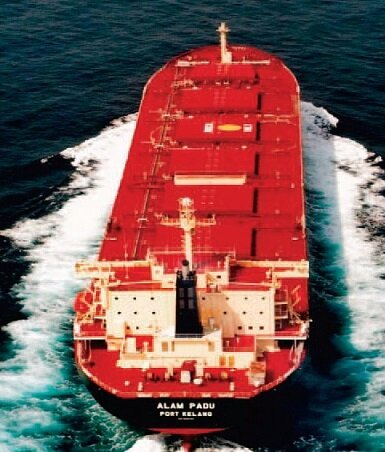
Solid bulk cargo Any material, other than liquid or gas, consisting of a combination of particles, granules or any larger pieces of material, generally uniform in composition, and loaded directly into the cargo spaces without any intermediate form of containment.
The cargoes carried by bulk carriers, ranging from "clean" foodstuffs to "dirty" minerals and including those that may react with each other or with sources of contamination such as water, mean that care must be taken to ensure that cargo spaces are properly prepared for the particular cargo to be loaded. Cleaning must be adequate for the cargo to be loaded and will usually require a surveyor to pass the space as suitable for loading. It is essential that residues of a previous cargo are removed to ensure that contamination does not occur.
Damage to bulk cargoes is mainly caused by water, thus, not only must the holds be dry to receive cargo but hatch covers must be watertight or, if necessary, sealed to prevent ingress of water.
All fittings in the hold (ladders, pipe guards, bilge covers, etc.) should be examined to ensure that they are in good condition and securely fitted. Such pieces of equipment might cause serious damage to conveyor belt systems and consequent delays, for which the ship will be held liable, should they be inadvertently discharged with the cargo.
Bulk carrier, bulker A vessel designed to carry dry cargo, loaded into the vessel with no containment other than that of the ship,s boundaries, as distinguished from the liquid bulk carrier or tanker. Conventional bulk carrier is constructed with a single deck, single skin, double bottom, hopper side tanks and topside tanks in cargo spaces.
Bulk carriers are designed to load a maximum deadweight of any type of bulk cargo from heavy ore to light grain . The loading, carriage and finally the discharge of dry bulk cargo is not as simple or straight forward as most people would imagine.
Fig: Gearless bulk carrier
Many bulk cargoes have hazardous properties, or can change their properties on passage. The ship can be easily damaged by incorrect loading e.g. loading a forward hold to it maximum can cause the ship to bend. This stress can have life threatening results at sea in rough weather.
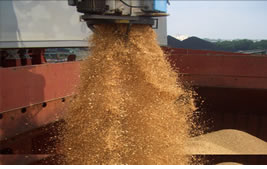
Residues from previous cargoes can also seriously effect latter cargoes. Water damage can also have devastating effect on some bulk cargoes e.g. cement power. It is not easy to verify true weights or quantities of cargoes loaded or discharged. All these factors have a serious consequence on the methods of operation for the safe carriage of bulk cargoes. Discharging bulk cargo using grab
Bulk cargoes have an inherent tendency to form a cone when they are loaded if conveyor belts or similar systems are not supervised and controlled. The angle formed by this cone is known as the `angle of repose' and varies with each cargo. Cargoes such as iron ore will form a steep angled cone, whereas cargoes that flow freely form a shallow angled cone. A cargo with a low angle of repose has the potential to shift during passage.
For some cargoes, bulldozers may be required to spread the load into the sides of the holds as cargo is nearing completion.
Most dry-bulk carriers depend on shoreside facilities for cargo loading and discharge, but some bulk carriers have self-unloading features with conveyors below the cargo holds, or with cranes on deck. Outlined below some of the more common bulk cargoes and their properties:
Coal
Coal is transported on all types of bulk carriers from handy size to VLCBs. However, it is not an easy or straight forward cargo to handle. It can emit methane gas and it is self-heating. In addition coal contains sulphur which causes severe corrosion when in contact with the ship's steelwork.
In most ports the cargo is loaded wet to reduce dust. Much of this moisture settles on passage and is pumped out through the ship's hold bilges which means that less weight is discharged than is loaded.
This cargo is loaded very fast, 10,000 tonnes an hour is not unusual. The loading and de-ballasting of the ship must be meticulously planned to ensure that the vessel is not overstressed. There is very little chance of damaging the cargo but the ship can receive extensive damage during the discharge operation from the equipment used.
Many different types of concentrates are handled in various parts of the world and in varying quantities. Most of these cargoes are extremely heavy and have a low transportable moisture limit (TML).
This means that if the moisture content of the cargo become greater than the TML the cargo can liquefy and turn into a slurry. When this happens on board, the cargo moves from side to side as the ship rolls which reduces the ship's righting lever. It does not require much cargo weight to capsize the vessel when this happens, it a loss of stability due to free surface effect. Some of the most dangerous cargoes where this can happen are copper, lead or zinc concentrates, magnetite, limonite and most pyrites.
One of the most difficult and dangerous cargoes to carry in bulk are grain cargoes. Most grains have an angle of repose (slip angle) of about 20° from the horizontal, which means that if the ship rolls more than 20° the cargo will shift. Then this happens the ship will develop a large list, lying on her side and still rolling will obviously cause a greater shift of cargo which in turn will capsize the vessel.
Most authorities therefore request that the master proves that his ship is capable of remaining stable even if the grain cargo shifts. This is done by the compiling of the Grain Loading Form which fully outlines the ships stability at the worse condition on passage.
Naturally grain cargoes, like any foodstuff, are susceptible to claims with contamination from a previous cargo and in addition can easily be damaged by water.
Vermin can also be a problem. Cargo holds must be clean and dry prior to the loading of any grain cargo and most grain charters demand a survey of the ship's hold prior to loading for this reason.
Obviously any moisture is going to ruin a cargo of cement but probably a greater danger to the vessel is the dust that can be produced during the loading and discharge of the cargo. If it is not removed promptly or gets into the ship's air intakes it can cause some long term problems to the vessel.
Salt- Salt, strangely enough, is not damaged from water, in fact the cargo can be loaded slightly moist. However, it can get rust stained from the ship's steelwork, therefore the ship must cover all the steel within the cargo hold with a lime wash solution thereby keeping the salt off the steelwork.
Again a supposedly harmless cargo that does have some hidden dangers. Some shipments many be subject to oxidation leading to depletion of oxygen and an increase of carbon dioxide in the cargo hold and adjacent spaces.
Fig: Bulk terminal woodchip loading
In addition, woodchips can be easily ignited by external sources, it is readily combustible and can also ignite by friction. The stowage factor can vary greatly with this cargo depending on the wood type, the moisture content and the type of loading head used. Even different loading operators can achieve varying stowage factors with the same cargo.
Although every effort have been taken to improve the accuracy of content provided the publisher of this website cannot gaurantee for errors. DisclaimerPrivacy policyHome page