Operation of self -unloading bulk carriers involved numerous hazards and careful considerations are important during all aspect of shipboard activities. Following are some basic guidance for safe working practices onboard and environment protection.
Read the instruction manuals prior bulk cargo handling
Make sure all guards are in place before start-up
Isolate/lockout power before commencing any maintenance work
Avoid contact with any moving parts
Beware of pinch points where the conveyor belt runs into a pulley.
Keep loose sleeves, gloves, cleaning rags away from moving parts.
Provide guard rails, or methods of protection while working near running conveyors.
Do not exceed design loads or service condition.
Do not modify equipment without proper authorisation.
Do not remove protective shields, guards, covers or any warning signs.
Wire rope clips on take-up assemblies must be checked and retightened after training the belt.
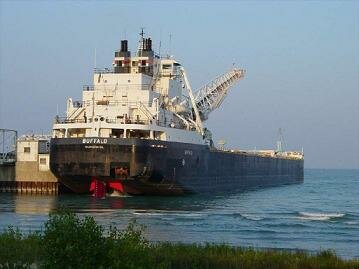
Fig:self unloader BUFFALO
The safety cables are to prevent the pulley assembly from falling if the belt breaks, these should be checked regularly.
Never use hands to check for hydraulic leaks.
Do not step on coupling guards or protective covering.
Do not try to remove a fallen object on the running belt, pull the pull chord if required.
Do not cross over or under conveyor belts and machinery, use the catwalks or walkways provided.
Do not reset emergency switches without verifying the reason for them being activated.
Do not enter the Loop area without authorisation, be cautious of any falling cargo, and remember that dusty cargo will impair your visibility.
Persons making rounds of the SUL system are required to inform the CCR their whereabouts.
All personnel are to know the position of all emergency stops and pull chords.
All walkways must be clear of obstructions.
All wiring must be insulated and clamped in position.
Portable lights if required to use must be guarded and intrinsically safe.
All tunnel lighting must be covered and intrinsically safe.
Protect the conveyor belts adequately before carrying out hot-work in the vicinity.
Hydraulic oil will flash on introduction of heat and start a fire, especially hydraulic oil spread on water.
All light and sound signals must be understood by all.
All communications must be relevant and clear.
All electrical switchboards must be protected from dust, especially coal and grain dust which is inflammable.
Protective Clothing
Protective clothing as appropriate must be worn at all times during cargo operations as follows:
Safety helmet with strap.
Steel toe safety shoes.
Leather working gloves
Working coverall.
Clear safety goggles.
Dust mask.
Safety torch.
Carry strap and protective cover for walkie-talkie set.
Safety Measures Incorporated in the System
Audio Visual alarms:-
Red Light indicates shut down
Yellow Light indicates alarm
O speed shut down for motors: - indicates if there is pulley slippage relative to the left speed. This avoids friction damage to the underside of the belt.
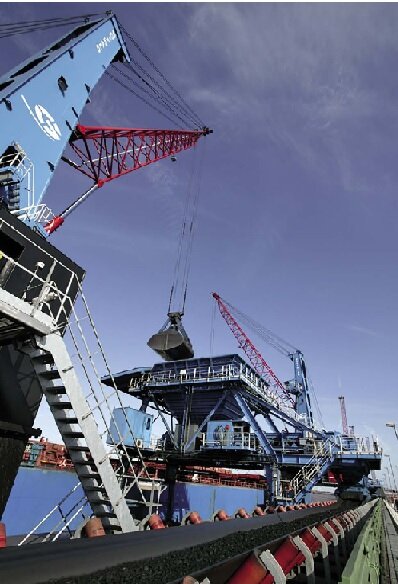
Grab discharge of coal onto a conveyor
Tunnel lights:-
Indicates the load as follows:
Red light - overload
Amber - correct Load
Green - low load
The emergency stops and pull cords:- These switches when activated, stop the system sequentially. They are to be activated in an emergency situation, or when personnel are working on the system.
Transfer hopper pressure switches:-
These switches are activated by a build up in pressure due to clogging in a transfer hopper, and stop the hold conveyor.
The Listometer lights:- These lights are fitted on the foremost and loop-line. They indicate the vessels list as follows:-
Port List - 1 Red = ½ degree
Port List - 2 Red = 1 degree
Port List - 2 Red Flashing = more than 1 ½ degrees
Starboard List - 1 Green = ½ degree
Starboard List - 2 Green = 1 degree
Starboard List - 2 Green Flashing = more than 1 ½ degrees
Maintaining the vessel in an upright condition is critical, and lists in excess of 1 degree must be corrected.
Lists of more than 1 degree can lead to the following problems:-
Faults in the tracking of the belts
The boom slewing system hydraulics may exceed the design pressures, and the relief valves will lift, stopping the boom.
There are no heat or smoke sensing systems in the loop-tunnel, and regular fire watches must be arranged especially during repairs. These watches must be carried out at least two to six hours, following completion of any hot work in the loop and tunnel areas.
Note that there are no heat or smoke sensors in the Loop-Tunnel, and therefore frequent fire rounds have to be made by the persons assigned, especially when the system is in operation, and when carrying out repairs. Fire rounds are to be taken at least two and six hours after completion of any hot-work in the Loop and Tunnel areas.
Precautions when Bunkering During Loading/Discharging:
Notices must be posted and warnings issued to all concerned to the effect that bunker hoses are connected.
Alterations in draft and trim due to bunkering must be closely monitored, to ensure that an adequate depth of water at the berth is maintained, and that excessive trim which would adversely affect the boom and conveyor belts, is avoided.
Cargo operations
During cargo operations, gangways should be periodically inspected for cleanliness, tightness of handrail lines, deployment angle, safety net placement, and distance of the bottom step plate from the wharf. Any dangerous conditions on the gangway should be corrected.
It is good practice to keep a log at the top of the gangway, so that the longshoremen can sign on when they board the ship and sign off when they leave. The log also serves a practical purpose, as it enables the crew to check who is on board and to ensure that all of the longshoremen have left the ship when cargo operations are completed.
The main deck should be inspected at regular intervals (including areas where longshoremen are or will be working and also access routes to these areas) to make sure that there is no oil, grease or any foreign substance on deck. Any open manhole covers should be closed or properly guarded and guards or cautionary signs should be placed around any obstructions on deck that may present a trip hazard. Crewmembers should ensure that any ship equipment or areas under their active control during cargo operations do not pose a danger to the longshoremen working near the equipment or passing through the area controlled by them.
Crew should also make deck log entries of the periodic inspections of the gangway and main deck confirming they are clean and in good working condition. They should also note the time of any cleaning/maintenance on the gangway or main deck, specifying the area cleaned.
Reference publications :
SOLAS 74 + amendments
Merchant Shipping Notice M673
MARPOL 73/78
BCH/IBC Code
SOPEP
Vessel Response Plan
Guide to Ship Fire Fighting BR4007
BC Code
International Code for the Safe Carriage of Grain in Bulk
Although every effort have been taken to improve the accuracy of content provided the publisher of this website cannot take responsibility for errors. DisclaimerPrivacy policyHome page